What about the queer
Transdwelling.
Before knowing what the role in society of trans people is (if they have one at all), we should first talk about what it means to be trans. Usually, trans people are referred to as people who do not feel identified with their sex, people who are born in the wrong bodies, or people who wish to undergo a sex transition. While being a trans person is being a person whose gender identity is different from their sex assigned at birth, this can be a little confusing, as terms tend to become blurred. According to the FELGTBI+ (Spanish Association) (2020):
“Trans person is a general and inclusive term that encompasses those people whose gender identity and/or expression is different from the cultural expectations based on the sex assigned to them at birth. It includes transsexual people, transgender people, non-binary trans people, those with fluid gender expression, and other gender variations.”
A trans person is, therefore, any person who does not feel identified with those gender labels that are imposed at birth through sex. This, however, is where many of the problems of understanding about trans people often begin. Using elements or performing actions that are not presumed to be part of the norm of the gender assigned to one at birth, such as wearing feminine clothing as a man or not shaving as a woman, does not imply transness. Being trans is a matter of identity. Likewise, the very concept of trans is still open to debate. Within the collective itself, there is a dispute between the terms trans, transgender, and transsexual, often attempting to dictate correct and incorrect ways of what it means to be trans, transgender, or transsexual. Something on which there is relatively general consensus is that the concept of trans is an umbrella concept that encompasses many ways of experiencing dissidence of identities, as well as separating it from purely medical notions (Iturri 2021, p. 17). But as an umbrella term that encompasses so many gender identities, what are these identities?
“The trans does not exist from the beginnings of history as we know it today. Trans identities are also situated and have their origin in the profound social changes generated by advances in medicine and the neoliberal turns that are favouring a change, fragmentation, and emphasis on individual identities, as reflected, for example, in identity politics” (Iturri 2021, p. 16).
The trans has been conceived through pathologisation ever since its reality became visible. Today, this pathologisation continues, especially from psychiatry, which “pathologises gender dissidence and places upon individual responsibility a collective problem derived from the gender system” (Iturri 2021, p. 18). Moreover, the first category to emerge regarding this dissidence was homosexuality itself, since homosexual people were considered to feel like the opposite gender because, for example, a man who liked another man would actually possess the desires of women (Iturri 2021, p. 19). In the 1950s, the concept of transsexual was established for people who continuously feel they are of the opposite sex, differentiating it from homosexuality and transvestism, with medicine itself and the advance of science and technology enabling the very existence of transsexuality (Iturri 2021, p. 19). As a result of this entire evolution of conceptions, it is interesting to reach the conclusion that homosexuality was understood as transsexuality by redirecting all sexual orientations towards heterosexuality, thereby reinforcing the interrelationships between sex, gender, and sexual orientation, as well as the compulsory heterosexuality that queer theories of the early this century discussed.
“In short, the identity of transsexual people is constructed in a circular way: medical standards create a profile that one must adjust to in order to access certain procedures influenced by social construction and, in turn, social construction is fed back by medical discourse. This way of understanding the trans arises, therefore, from the advance of science, the flexibilisation and relaxation of gender roles, and the influence of Anglo-Saxon models that place us in a Western and situated way of conceiving gender.” (Iturri 2021, p. 20).
What would happen if everything were trans-something? What would happen if we were trans-everything? Would something be trans-something if everything is trans-something? What happens when everything is trans-something and trans-something disappears? Would we still call everything trans-everything? Or would we remove the prefix and be able to start calling everything trans-something again?
The prefix trans- in language is nothing more than a way of expressing “behind”, “on the other side of”, “through”, “that crosses”, “that is beyond”. The transdisciplinary is only that which is beyond discipline. The transhuman is only that which is beyond the human. But the trans is violence. Are we really violence? When did we start being violence? When did we even start being violent? When we started to respond. When we started to dwell with and in violence. When we started to dwell in violence. When we started to inhabit violence.
If we have not had the opportunity to live without violence, logic pushes us to think that we must redirect that violence and drag it onto our own terrain. To appropriate what is against our existence and turn it into our own demand: to turn violence into our comfort zone (García 2022) and pass it through our own filters. To turn the precarisation we have been pushed into into a tool for escape and demand. To turn the element of the grotesque that has been imposed upon us, with which we have been defined as an identity element, into the fluid image in which we dwell. Just as we have appropriated cultural elements of oppression, we will appropriate the violence imposed on us. We will gather the bricks of violence that have been thrown at the back of our necks and with them we will build our zone, our space. We will inhabit violence and create new bricks, which we will return with intensity. We are violence because it is all we inhabit. We are violence because it is all that is left for us.
Dissenting and rebelling.
Speaking of dissenting can also function on a spectrum in the sense that there are hundreds of manifestations of dissent. From critique, through opposition and protest, to terrorism. This spectrum is, in turn, much more confusing, because spectra are usually understood as a line (or a rectangle) where different elements are positioned, with the limits understood as the extremes. However, in this case, the extreme where critique is positioned is not understood as an extreme by the general public.
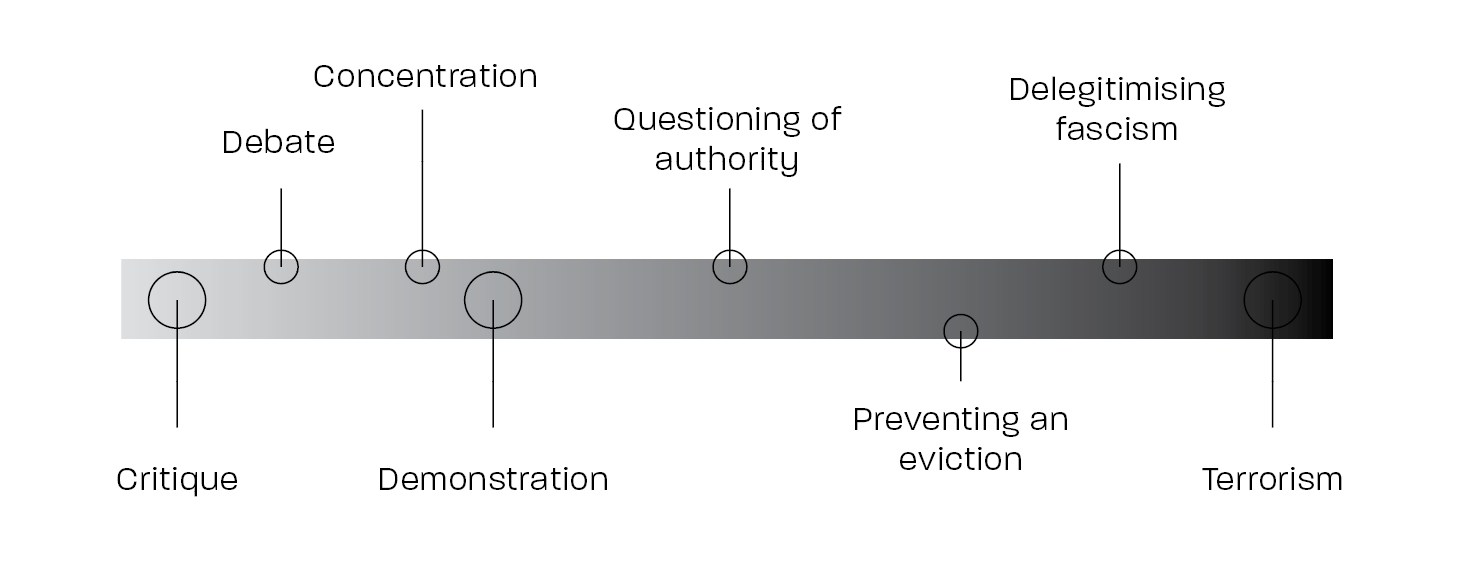
This spectrum, therefore, functions much more like a scale of levels, where critique is usually understood as moderation and democracy, while terrorism, as a mode of dissent, is understood as extremism. Although I will not deny how understandable this expression is, and I could never compare critique (or the use of word) to terrorism, it is fascinating how difficult it is to place state terrorism here. Is this violence on the part of the state, then, not a form of dissent against the citizenry? In reality, dissenting is something that only the citizenry can do, because the state does not need to go through that step; it has the capacity to directly impose its opinion since, of course, it possesses all the mechanisms of the monopoly on violence. There is also something that only the citizenry can do: rebel. With the concept of rebellion, I do not intend to encourage a coup d’état, but rather to actively position oneself against what is imposed and, above all, against state violence.
Dissenting, moreover, becomes not an obligation as it tends to be expressed but a necessity. And in itself, according to the previous section of this chapter, transdwelling is a form of dissent. Dissent becomes a necessity at the moment it becomes the only way to see the light at the end of the tunnel (without reference to death), knowing that the only way out of the survival loop and to finally begin to live is to rebel against everything that exists, against everything that is given to us, against everything we suffer. Let us begin to live, by dissenting and rebelling. Rebellion of spaces, of culture, of transit, of transition, of violence. The rebellion against the established order is our way of beginning to live, in order to have the possibility of dying with dignity.